
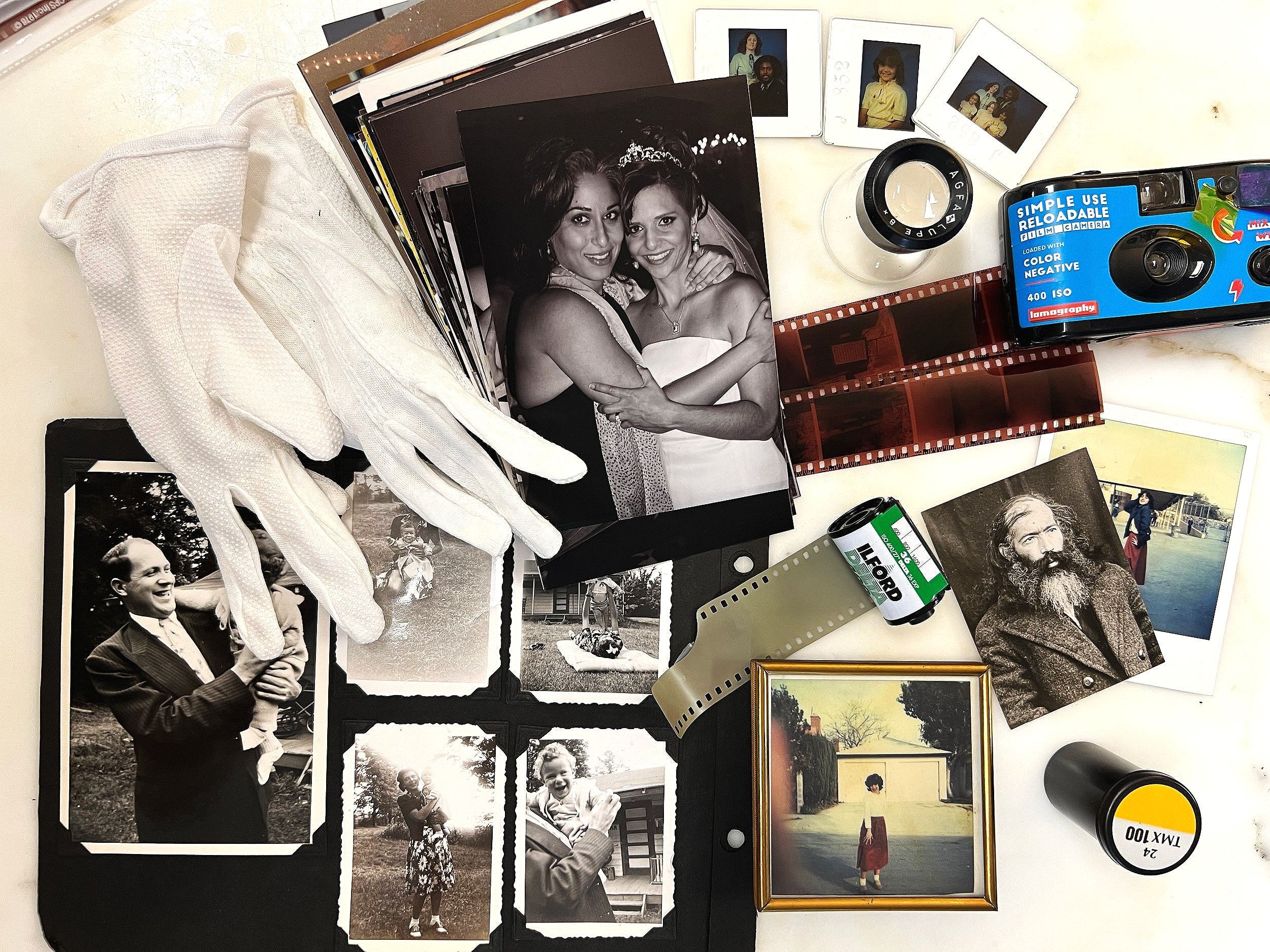
We scan everything.
And we do it once, the right way.
PHOTO & DOCUMENT SCANNING · PLAYA VISTA STUDIO
Not just scanning.
Your photos organized, renamed, and dated before it comes back to you.
Most families have decades of photos scattered across formats that are actively deteriorating. Printed photos fading in shoeboxes. Slides and negatives sitting in envelopes nobody has opened in years. Old photo albums with pages turning brittle. Documents — birth certificates, marriage records, military papers, letters — stored in conditions that won't preserve them much longer.
Professional photo scanning is the process of converting these physical memories into high-resolution digital files that are safe, searchable, and shareable. At Picturli, we scan printed photos, slides, negatives, film negatives, photo albums, scrapbooks, documents, and three-dimensional memorabilia — all at archival quality using the same camera scanning systems found in museums and archives worldwide.
Every project starts with organization, not scanning. We go through your collection first, remove duplicates and damaged photos that can't be saved, and build a chronological structure before a single photo touches our equipment. That's what separates professional photo archiving from a pile of digital files.
Then we scan. Photo prints are digitized at 600 PPI. Slides and negatives at 4,000 PPI — capturing more detail than any print made from them. Every file comes back renamed with a descriptive title, re-dated to reflect its original date, and tagged with family names and places. Your entire collection arrives organized chronologically and searchable on any platform, any device.
We serve families in Los Angeles and clients across the United States and internationally. Our studio is located in Playa Vista, California.
What We Scan
Every format you've ever heard of.
And some you haven't.
What happens after my photos are scanned?
Once your collection is scanned, organized, and tagged with names and places, we deliver everything on a USB drive or external hard drive. We also help you build a backup strategy — recommending online platforms where your archive is accessible from any device and shareable with exactly who you choose. We'll walk you through the options that fit your level of technology.
PHOTO SCANNING FAQ
-
Failing to digitize your photos can lead to irreversible loss and damage over time. Physical photos, albums, slides, and negatives are vulnerable to:
Fading and discoloration from exposure to light, air, and humidity
Damage caused by water, fire, or natural disasters
Deterioration over time due to the breakdown of materials
Loss or misplacement during moves or reorganizations
At Picturli, our photo digitization services safeguard your memories by converting them into high-quality, digital formats that are:
Safe and secure from physical damage and disasters
Easily searchable and organized with metadata and date stamps
Accessible anywhere on modern devices and platforms
Simple to share with friends and family
Our photo digitizing process is designed to preserve the integrity and detail of your originals, whether you’re scanning prints, albums, slides, or negatives. By investing in photo conversion, you ensure your family’s story is protected and ready to be enjoyed by future generations. Don’t wait for disaster to strike — digitize your photos today and enjoy peace of mind knowing your memories are secure.
-
Analog media refers to traditional, non-digital formats used to capture and store images, audio, or video. In photography, analog media, aka analogue media, includes film photos, camera film, and formats like photo film and film pictures created using film cameras. Unlike digital media, which stores information as binary data, analog media relies on physical processes to record light, sound, or motion.
Examples of analog media include:
Film photos and negatives created with film cameras
Slides and transparencies
Printed photographs from traditional darkroom processes
Although analog formats are timeless and tactile, they are more prone to fading, damage, and loss over time. At Picturli, we specialize in preserving these cherished memories through photo digitization, ensuring your analogue media is converted into secure, high-resolution digital files that can be easily accessed, shared, and archived for future generations.
-
We have scanned various photographs from:
traditional color
black/white photo prints to
instant photographs captured on Polaroid
Fuji
Kodak and other instant film formats.
We also specialize in scanning vintage items, including:
Daguerrotypes
Ambrotypes
Tintypes
Real Photo Postcards
Stereo Cards
Stereographs
Cartes de Visite
Cyanotype
Cabinet Cards, and many more.
Our scans allow our clients to reprint their images, which often look way better than the originals, which have faded over time.
-
Scanning negatives is the best way to preserve your memories because negatives are the original form of the photo. Prints are copies made from negatives and often don’t capture the full image. When photos are printed, parts of the image may be cropped, meaning you lose valuable details. Scanning the negatives ensures that the entire photo is preserved, including edges that may not have made it into the print.
Additionally, negatives provide the highest quality source for digitization. They hold more detail, better color depth, and greater tonal range compared to a print, allowing for superior digital reproduction. While scanning negatives is more labor-intensive and, therefore, more expensive, it offers the widest range of your memories with the truest representation of the original image.
Investing in negative scanning ensures that your photos are preserved in their purest form, capturing every detail just as it was originally taken. It’s a worthwhile step for creating a lasting, high-quality archive of your cherished moments.
-
At Picturli, we provide high-resolution scans that ensure your photos, slides, and negatives are digitized with exceptional clarity and detail. Using advanced image upscaler and image enhancer technology, we deliver files perfect for reprinting, sharing, and archiving.
Photo prints are scanned at 600 PPI, ideal for preserving fine details and creating high-quality enlargements.
Slides and negatives are scanned at 4,000 PPI, capturing every nuance for professional-grade results.
Our high-resolution files are designed to meet both archival standards and creative needs, making them suitable for everything from small keepsakes to large-format prints. Whether preserving family history or reprinting cherished memories, our process ensures your images are delivered in the best possible resolution.
-
Our philosophy for archiving is to do it once and do it right. We believe that the resolution we offer provides the best quality and longevity for your memories. That’s why we use a single, high-resolution standard for everything we scan — ensuring your photos, slides, and negatives are digitized with the detail and clarity needed for both viewing and future-proof archiving.
-
Negative and Slide Scanning
We specialize in preserving your film negatives and slides by converting them into high-resolution digital files. Using state-of-the-art camera scanning systems such as our negative scanners and film scanners, our process ensures exceptional clarity and detail while maintaining the integrity of your original photo negatives.
Our Process for Digitizing Negatives
Careful Handling: Each film negative is inspected and handled to prevent damage.
High-Resolution Scanning: We use advanced film scanners to capture every detail at up to 4,000 PPI, ensuring the finest digital reproduction.
Color Correction and Restoration: Our team enhances your images by restoring faded colors, removing dust and scratches, and adjusting exposure for a polished result.
Delivery in Digital Formats: Your digitized negatives are provided as high-resolution JPEG or TIFF files, making them easy to store, share, and reprint.
We also provide archival camera scanning services to capture a wide variety of negatives and slides, including:
35mm, 35mm half frame, 126, 127, 127 half frame, 110
Disc film, APS, 116/616, 120/220/620
Delicate glass plates
Our advanced scanning technology and expertise allow us to handle these diverse formats precisely and carefully, ensuring that every detail and nuance is captured. Our meticulous approach delivers high-quality digital versions of your negatives and slides, preserving your memories in stunning detail for generations.
-
We understand the value and sentimental significance of scrapbook pages and take utmost care in handling them during the scanning process to ensure their safety. Our experienced team follows meticulous procedures to protect your precious scrapbook pages from potential damage. We offer two options for scanning: scanning the entire page as a whole or carefully removing the photos from the page and scanning them individually.
Whichever option you choose, our top priority is to preserve your cherished memories while maintaining the originality and essence of your scrapbook pages.
-
Yes, because we scan at high resolutions, you can often enlarge your scans to three times their original size — or even more, depending on the material you're printing on.
-
Yes, if you have damaged photos such as tears, creases, cracks, stains, etc., we can scan them.
If your photo is an important memory, we offer optional photo restoration to return it to its original condition.
-
For small collections, we deliver them on a USB drive. And for larger collections, we use an external hard drive.
Our studio also specializes in providing an online platform that is best suited to your criteria.