
Why Your Photos Won’t Survive the Next 20 Years (And What to Do About It)
I want to tell you something that most people in my industry are afraid to say directly.
Your photos are degrading right now. Not eventually. Now. Every year you wait, you lose a little more. And for some formats, once the damage is done, it cannot be undone.
I’ve seen it too many times. A client brings in a box of VHS tapes from the 1980s and we do our best, but the image quality is already compromised. Someone finds slides in a garage in Woodland Hills and the emulsion has started to separate. A hard drive from 2010 clicks twice and stops spinning. Everything on it, gone.
This isn’t a scare tactic. It’s physics and chemistry.
What’s actually happening to your physical photos
Print photographs fade from exposure to light, humidity, and air. The dyes that make up color prints are unstable over time. A color print stored in a typical home environment can lose significant density and color accuracy within 25 to 50 years. Black and white prints last longer, but they’re not immune – improper storage accelerates deterioration significantly.
Slides and negatives are particularly fragile. Color slides from the 1970s and 1980s suffer from dye fading, and many show significant color shifts that cannot be fully corrected even with professional restoration. Negatives stored in acidic envelopes or plastic sleeves can develop a condition called vinegar syndrome, where the film base breaks down and releases acetic acid – which then damages everything stored near it.
Albums from the 1960s through the 1990s are some of the worst offenders. Those magnetic “sticky” albums were convenient at the time, but the adhesive migrates into the print over decades, causing staining and chemical deterioration that’s irreversible. If your family photos are still in one of these albums, getting them out is urgent. I shudder to think that they’re coming back but hopefully by now more people know the dangers of using them.
What’s happening to your video tapes
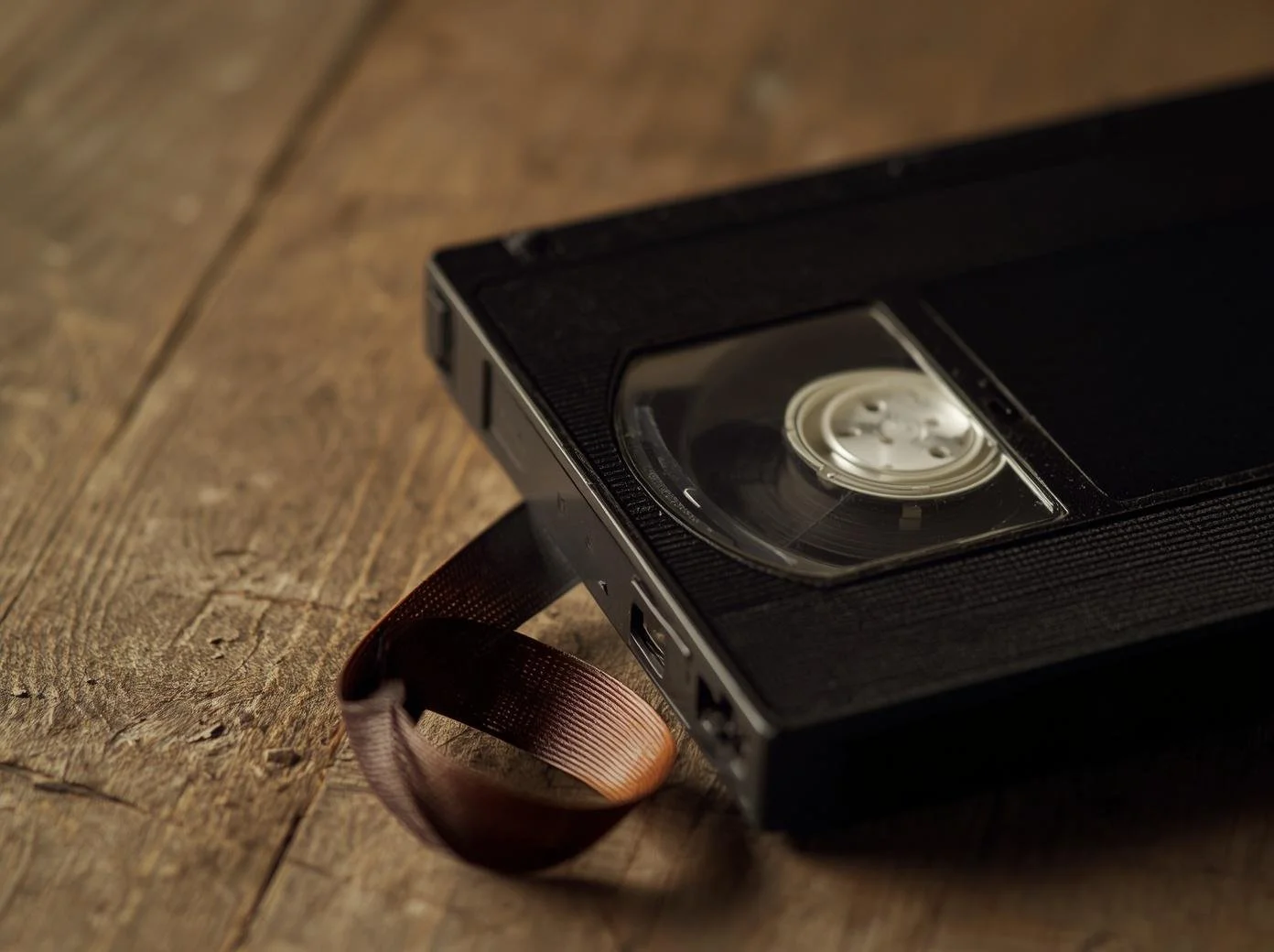
VHS, Hi8, Video8, and MiniDV tapes all degrade through a process called hydrolysis – the magnetic particles that hold the recorded image absorb moisture and begin to separate from the tape binder. A VHS tape stored in average conditions loses roughly 10 to 20 percent of its signal quality every decade. A tape from 1985 has already lost 30 to 40 years of quality.
There’s also a condition called sticky shed syndrome, where the binder coating becomes tacky and causes the tape to stick to the playback heads, sometimes destroying footage in the process. We encounter this regularly at our studio. In some cases we can treat and recover the tape. In others, the damage is too far gone.
MiniDV tapes are more stable but not immune. And the equipment to play them back is becoming increasingly rare. Every year that passes, it gets harder to find a functioning deck.
If you have home movie tapes, the time to digitize them is now – not next year, not when you have time. Now. I go into more detail on what the conversion process involves in my post on how to do a complete family photo inventory and on our VHS and video conversion page.
What’s happening to your digital files
People often assume their digital photos are safe. They’re not; in fact, they’re the most vulnerable.
Hard drives have an average lifespan of three to five years under regular use. Many fail without warning. There’s no creaking, no slowing down. The drive simply stops working one morning. If you have photos on a hard drive that you haven’t accessed in several years, there’s a real chance it has already failed and you just don’t know it yet because you haven’t tried to open it.
CDs and DVDs, once thought to be permanent, are not. Consumer-grade optical discs have a realistic lifespan of 25 to 100 years depending on storage conditions – but “realistic” under poor conditions can mean 10 years or less. The data layer oxidizes, and files become unreadable.
Cloud storage is more reliable, but it is not a backup strategy. A single cloud account is a single point of failure. Services shut down (remember Kodak Gallery and Costco Photos), accounts get locked, billing lapses. Shutterfly has already changed its terms significantly. What’s free today may not be free tomorrow.
What preservation actually looks like
Proper preservation has two components: digitization and backup.
Digitization means converting your physical media to digital files at archival resolution – 600 PPI for prints, 4,000 PPI for negatives and slides, MP4 for video. Not the resolution a drugstore scanner uses. Not the resolution a mail-in service uses when they’re scanning 500 photos for $50. Archival resolution. The kind that holds up when you need to make a large print 20 years from now, or when restoration technology improves and you want to reprocess the original file.
Backup means multiple copies, in multiple locations, using the 3-2-1 method: 3 copies, on 2 different types of media, with 1 stored offsite. A copy on your computer and a copy on an external drive sitting next to your computer is not a backup strategy – one flood, one fire, one theft takes both. Read more about the 3-2-1 backup system in my post on how to keep your photo library from falling apart.
The question I hear most often
People ask me: do I really need a professional to do this, or can I do it myself?
Honestly – some of it you can do yourself. Consolidating digital files, setting up a backup system, organizing your library. I write about all of that here and I want you to have the information whether or not you ever work with us.
But digitization is different. The equipment matters. The resolution matters. The handling matters. A flatbed scanner from a big box store is not the same as the camera scanning system used in museums and archives. And for fragile or damaged media – deteriorating slides, sticky tapes, faded negatives – professional handling isn’t optional. It’s the difference between recovering a memory and losing it permanently.
If you’re not sure what condition your collection is in or where to start, that’s exactly what a consultation is for.